*Japanese Word of the Day*
最近(さいきん)、絵(え)を描(か)くのにハマ(はま)ってるんだよね。
/saikin, e wo kaku no ni hamatterun dayone/
I'm recently hooked on painting a picture!!
*最近(さいきん) /saikin/ recently, these days
*絵(え) /e/ a drawing, a painting, a sketch, a illustration
― 絵(え)を描(か)く /e wo kaku/ to draw/paint a picture
*~にハマ(はま)っている /...ni hamatte iru/ to be hooked on, to be into
When we speak, this い is often omitted.
You may thought what の between 絵を描く and ハマってる means. It's one of the particles! It's added after a verb to change it into a noun. Sometimes we use こと instead of の. (Or, we use の instead of こと sometimes?? I'm not sure...)
◎ 絵を描く の にハマってる。
◎ 絵を描く こと にハマってる。
× 絵を描く に ハマってる。
Read this post to know the other usage of の. :)
→ の=of ?
Actually, I'm into painting with oil pastels! I recently upload some of my paintings on Pinterest. Please visit my page if you're interested. :3
And I want to add one more phrase today.
最近(さいきん)、ハマっていることはありますか?
Guess what it means, and let me know your answer! haha
By the way, I found a very interesting blog post!!
How to Write in Japanese - A Beginner's Guide
This is a step-by-step guide to reading and writing Japanese, Kana and Kanji.
That's all for today! Thank you for reading. See you next time! :)
Related post:
Kanji Lesson
Japanese is easier than you think!
Monday, April 27, 2015

Thursday, April 16, 2015
How long do you stay?
*Japanese Word of the Day*
何泊(なんはく/なんぱく)する予定(よてい)?
/nanhaku(nanpaku) suru yotei?/
How many nights do you plan to stay?
三泊(さんぱく)四日(よっか)だよ。
/sanpaku-yokka dayo/
For 4 days and 3 nights.
You can say only 三泊(3 nights) instead of 三泊四日(4 days and 3 nights), but we usually say the latter. 泊 means "to stay" and it's pronounced as はく/haku/ or ぱく/paku/.
・一泊(いっぱく)二日(ふつか) 2 days and 1 night
・二泊(にはく)三日(みっか) 3 days and 2 nights
・三泊(さんぱく)四日(よっか) 4 days and 3 nights
・四泊(よんはく/よんぱく)五日(いつか) 5 days and 4 nights
・五泊(ごはく)六日(むいか) 6 days and 5 nights
*~泊する/...haku(paku) suru/ to stay ... nights
・一泊(いっぱく)する
・二泊(にはく)する
・三泊(さんぱく)する
*予定(よてい)/yotei/ a plan
*~する予定 /...suru yotei/ I'm going to ...
今週(こんしゅう)の日曜日(にちようび)何(なに)か予定(よてい)ある?
/konshuu no nichi-youbi nanika yotei aru?/
Do you have any plans for this Sunday?
明日(あした)は友(とも)だちと遊(あそ)びに行(い)く予定(よてい)。
I'm going to hang out with my friends.
I took a trip to Matsu Island, which is one of the small islands in Taiwan. It was a 4-day trip (三泊四日). I stayed in a pretty village, Chinbe Village, which has a beach right in front of it.
It was foggy on the last day. All flights cancelled due to dense fog, so I tried to get a ferry ticket instead. It would take 7 hours from the island by ferry but it was the only way to go back. There were a lot of people in the small port. It was exhausting and stressful... I couldn't buy a ticket after all. They ran just one ferry a day, and they were close the next day.
I heard that there was another route to go back to Taiwan: Take a ferry to China first, and then take a plane to Taiwan. So I tried anything I could do. It was hard but a great practice speaking Chinese! :'D Unfortunately, the ferry also cancelled. I had to wait until the fog was cleared. I ended up staying 2 more days!
Anyway, it was a nice trip.
何泊(なんはく/なんぱく)する予定(よてい)?
/nanhaku(nanpaku) suru yotei?/
How many nights do you plan to stay?
三泊(さんぱく)四日(よっか)だよ。
/sanpaku-yokka dayo/
For 4 days and 3 nights.
You can say only 三泊(3 nights) instead of 三泊四日(4 days and 3 nights), but we usually say the latter. 泊 means "to stay" and it's pronounced as はく/haku/ or ぱく/paku/.
・一泊(いっぱく)二日(ふつか) 2 days and 1 night
・二泊(にはく)三日(みっか) 3 days and 2 nights
・三泊(さんぱく)四日(よっか) 4 days and 3 nights
・四泊(よんはく/よんぱく)五日(いつか) 5 days and 4 nights
・五泊(ごはく)六日(むいか) 6 days and 5 nights
*~泊する/...haku(paku) suru/ to stay ... nights
・一泊(いっぱく)する
・二泊(にはく)する
・三泊(さんぱく)する
*予定(よてい)/yotei/ a plan
*~する予定 /...suru yotei/ I'm going to ...
今週(こんしゅう)の日曜日(にちようび)何(なに)か予定(よてい)ある?
/konshuu no nichi-youbi nanika yotei aru?/
Do you have any plans for this Sunday?
明日(あした)は友(とも)だちと遊(あそ)びに行(い)く予定(よてい)。
I'm going to hang out with my friends.
I took a trip to Matsu Island, which is one of the small islands in Taiwan. It was a 4-day trip (三泊四日). I stayed in a pretty village, Chinbe Village, which has a beach right in front of it.
.jpg) |
| Chinbe Village |
.jpg) |
| The hotel I stayed |
I heard that there was another route to go back to Taiwan: Take a ferry to China first, and then take a plane to Taiwan. So I tried anything I could do. It was hard but a great practice speaking Chinese! :'D Unfortunately, the ferry also cancelled. I had to wait until the fog was cleared. I ended up staying 2 more days!
Anyway, it was a nice trip.
Monday, March 30, 2015
Learn From Mistakes
失敗(しっぱい)は成功(せいこう)のもと
/shippai wa seikou no moto/
This is a Japanese proverb, which means "Every failure is a stepping stone to success".
Do you have the same proverb in your native language? :)

Making a mistake isn't bad at all. You can learn through mistakes. Not only your own mistakes, but also other people's mistakes. I found an interesting blog post which explains how to learn pronunciation/grammar/native-like communication skill while speaking your native language, by observing other people's mistakes.
Learn Better Pronunciation While Speaking Your Native Language
It also mentions about Japanese language/people.
It reminds me of our English teacher in junior high school. He got angry when we speak English with strong Japanese accent like "あい あむ あ すとぅーでんと" (can you guess what it means?). XD
Speaking of which, some Japanese students often make the same kind of mistake, like "I am like dogs", when they should say "I like dogs." It's funny, huh? I guess it is because they're taught that be-verbs are translated as "~は・・・です". "A is B" becomes "AはBです". They directly translate Japanese sentence "私は犬が好きです (= I like dogs)" into English. :(
Actually, "~は・・・です" is not a be-verb. We add です at the end of the sentence to make the sentence polite. は is so called the particle which shows the topic of the sentence.
Also, the word order in Japanese is really different from English! I've written about the difference between the Japanese word order and the English word order. Here's the example sentence I wrote.
昨日 / 公園で / 父が / 寝ているのを / 見た。
I saw my father sleeping at the park yesterday.
Japanese speakers describe things from circumference, while English speakers center its subject and its verb.
It's considered as rude to jump into conversation or interrupt when someone else is speaking, but we give あいづち frequently during conversation to show that we pay attention. Here's the post I wrote about it!
You can find a lot of "interesting mistakes" in lang-8, where many language learners post an entry in their target language to get corrections from native speakers. I've written about common mistakes in Japanese which I found through correcting my friends' entries.
That's all for today! Thank you for reading. :)
*Japanese Word of the Day*
大丈夫(だいじょうぶ)!
/daijoubu/
It's okay! No worries! No problems!
/shippai wa seikou no moto/
This is a Japanese proverb, which means "Every failure is a stepping stone to success".
Do you have the same proverb in your native language? :)
Making a mistake isn't bad at all. You can learn through mistakes. Not only your own mistakes, but also other people's mistakes. I found an interesting blog post which explains how to learn pronunciation/grammar/native-like communication skill while speaking your native language, by observing other people's mistakes.
Learn Better Pronunciation While Speaking Your Native Language
It also mentions about Japanese language/people.
My Japanese friends add extra syllables to words. “McDonald’s” becomes “Macu Donarudosu.” It’s useful as you can instantly speak hundreds of words of English origin in Japanese simply by sticking to the consonant-vowel pattern in the Japanese syllabary.
It reminds me of our English teacher in junior high school. He got angry when we speak English with strong Japanese accent like "あい あむ あ すとぅーでんと" (can you guess what it means?). XD
Japanese speakers will say “foreign country people,” an awkward way of saying “people from other countries.” The direct translation from Japanese causes this — gaikokujin — literally, foreign country people. Remembering the direct Japanese translation into English actually helps me remember the word in Japanese.
Speaking of which, some Japanese students often make the same kind of mistake, like "I am like dogs", when they should say "I like dogs." It's funny, huh? I guess it is because they're taught that be-verbs are translated as "~は・・・です". "A is B" becomes "AはBです". They directly translate Japanese sentence "私は犬が好きです (= I like dogs)" into English. :(
Actually, "~は・・・です" is not a be-verb. We add です at the end of the sentence to make the sentence polite. は is so called the particle which shows the topic of the sentence.
Also, the word order in Japanese is really different from English! I've written about the difference between the Japanese word order and the English word order. Here's the example sentence I wrote.
昨日 / 公園で / 父が / 寝ているのを / 見た。
I saw my father sleeping at the park yesterday.
Japanese speakers describe things from circumference, while English speakers center its subject and its verb.
When I speak Spanish, I don’t hesitate to jump into conversation quickly. However, when I speak Japanese, I allow a bit more room to breathe between speakers.
I simply used the fillers I had picked up from observing Japanese conversation — “so, so, so” to agree and “ehhh?” to show surprise.
You can find a lot of "interesting mistakes" in lang-8, where many language learners post an entry in their target language to get corrections from native speakers. I've written about common mistakes in Japanese which I found through correcting my friends' entries.
That's all for today! Thank you for reading. :)
*Japanese Word of the Day*
大丈夫(だいじょうぶ)!
/daijoubu/
It's okay! No worries! No problems!
Thursday, March 19, 2015
Vocabulary!!
Vocabulary! When we learn a foreign language, it would be the most important (and daunting!) part of learning. A language teacher can teach you some words, but they cannot memorize them in your place. We all have to learn it by ourselves.
So, how do you remember words? Maybe the most efficient way is to review the words when you're about to forget. Have you seen this graph before? It's so called the Ebbinghaus's Forgetting Curve.

The red line shows how information lost over time. As you see, if we don't attempt to review the words that we learned, it'd be lost in a couple of days! But as the green lines show, more we review it, the more stronger we make the memory, the longer we can remember it.
I found a nice infographic that explains about the Forgetting Curve.

Find more education infographics on e-Learning Infographics
I used to write words down on loose leaf paper and review it when I have time. As time went by, the number of sheets of paper got increased. I removed some paper which had words I already remembered on it. If there were words that I still didn't remembered yet, I wrote them again on the new sheet of paper.
I first wrote the word that I wanted to remember with red pen, and added a couple of sentences which included the word. I didn't write Japanese translation of it, but the example sentences helped me to remember the meaning of it. Sometimes I drew pictures, or some related words.
It was my best way to remember words. Well, it WAS. Now I use an app on my tablet! My husband bought it for me! Yay! XD
The app I'm using now is Anki. Maybe you know it already? Anki is one of the flash cards apps, which is based on the Forgetting Curve. I put new words by desktop app and review them on tablet. Here's its website! Check it out if you haven't tried!
By the way, I found a funny quiz! :)
How Japanese Are You?
I was "50% Japanese"! haha What's the other half?
*Japanese Word of the Day*
ピンポーン!!(ぴんぽーん)
/pinpoon/
Bingo! That's it! Exactly!
*It's also the sound of door bell "ding dong".
So, how do you remember words? Maybe the most efficient way is to review the words when you're about to forget. Have you seen this graph before? It's so called the Ebbinghaus's Forgetting Curve.
The red line shows how information lost over time. As you see, if we don't attempt to review the words that we learned, it'd be lost in a couple of days! But as the green lines show, more we review it, the more stronger we make the memory, the longer we can remember it.
I found a nice infographic that explains about the Forgetting Curve.
Find more education infographics on e-Learning Infographics
I used to write words down on loose leaf paper and review it when I have time. As time went by, the number of sheets of paper got increased. I removed some paper which had words I already remembered on it. If there were words that I still didn't remembered yet, I wrote them again on the new sheet of paper.
 |
| My Chinese and Persian notebooks! |
I first wrote the word that I wanted to remember with red pen, and added a couple of sentences which included the word. I didn't write Japanese translation of it, but the example sentences helped me to remember the meaning of it. Sometimes I drew pictures, or some related words.
It was my best way to remember words. Well, it WAS. Now I use an app on my tablet! My husband bought it for me! Yay! XD
The app I'm using now is Anki. Maybe you know it already? Anki is one of the flash cards apps, which is based on the Forgetting Curve. I put new words by desktop app and review them on tablet. Here's its website! Check it out if you haven't tried!
By the way, I found a funny quiz! :)
How Japanese Are You?
I was "50% Japanese"! haha What's the other half?
*Japanese Word of the Day*
ピンポーン!!(ぴんぽーん)
/pinpoon/
Bingo! That's it! Exactly!
*It's also the sound of door bell "ding dong".
Monday, March 9, 2015
How I Study a Language
Today I'm going to write about how I study Chinese through language exchange. I've been studied it for almost 2 years, since I moved to Taiwan. And it was my first challenge to learn a language without taking any classes.
I found that all successful language learners (like Benny of FI3M, Olly of IWTYAL, Timothy of Polyglotpal, and many other wondeful polyglots!!) learn languages by theirselves. They inspired me a lot, and made me notice that I also love languages. The most impressive word they gave me was:
So, if you're going to start learning Japanese or any other languages but you can't find appropreate classes near your house, don't feel disappointed. It's OK, you can learn it by yourself! :)
I said I started to learn Chinese since I moved to Taiwan, but actually I had 3 weeks before coming. I went to a libruary and borrowed the simplest book which introduces very basic Chinese grammer and phrases. I know some people would say that it's no good to start from learning grammer, but it worked for me. It was interesting to me to know how Chinese language is composed.
Simultaneously, I subscribed some Youtube channels which provide free lessons for beginners. I recommend Yangyang's lessons if you also want to start learning Chinese. ;)
I listened to an audio phrase book before sleep, and while sleeping. It helped me a lot to get used to the rythm of Chinese language. You know, it's really important to know how it sounds because Chinese is a "tone language". "Ma" with high pitched voice and "Ma" with low pitched voice have totally different meanings!
I found a website that you can download free audio files. I downloaded Persian from this website by the way. It's pretty nice. :)
→ 50 Languages
Japanese language is not so severe about pronunciation compared to Chinese, though some words are bit hard for foreigners to distinguish. (おばさん/obasan/ and おばあさん/obaasan/ are the totally different words!)
→ How to find a language exchange partner
You have to speak it if you want to be able to speak a language. It's true. Though I listened to the audio files almost everyday, my pronunciation was awfully terrible. I tried to speak the words I learnt but it always didn't make sense to my language exchange partner. She was patient and severe (in a good way!), so that I could train myself to improve my pronunciation.
If you want to learn a language by yourself, it'd be better to have someone who lets you output what you've learnt and corrects it. I've heard a lot of Japanese people say "I'll find someone to talk with... after I became good enough to speak". That's why they still can't speak it, and they'd never became "good enough". You know what I mean?
When we learn a language, we'd start with greetings and self-introduction.
→ Self introduction in Japanese
OK, then what should I talk though I don't have enough words in my vocabulary? Well, in my case, I tried to use the words and phrases that I learnt from a book or a Youtube lesson. So my "input" was always for "output". I mean, I was always thinking what to talk by using those new words when I study.
I tried to speak in Chinese as much as possible. It is my policy not to use English even if it takes a long time to tell her what I want to say. The more I struggle with, the more unforgettable it becomes. I hardly forget the words I learnt in that situation. (I never forget the word "towel" in Chinese!)
Here's some Japanese phrases for the first step language exchange! :)
→ Basic phrases for language exchange
→ Basic phrases for language exchange (2)
After I knew how to type Chinese on my laptop, I started to post some entries on Lang-8.com. I wrote things that related to myself, not just boring example sentences with the words I learnt. I got many corrections, and I used these corrected sentences when I talked with my language exchange partners. I also wrote about what I talked in language exchange. So I wrote/spoke/read the same words and phrases again and again.
Fortunately, I had more than one partner, so I could practice speaking same things more than once. :)
Here's the post I wrote about Lang-8 and how to type Japanese on your laptop.
→ How to type Japanese
I took an exam called TOCFL (Taiwan's national standardized test) last year. It was a bit hard to read a long sentences, but I could pass it at B2 level. Thanks to my all language exchange partners, I could reach upper-intermidiate level in a year. It's not as cool as those famous polyglots who get B2 level within half a year, but it meant a lot to me. :)
Now I still keep in touch with these language exchange partners. They're my best friends!
Well, that's all for today! I want to know how you study languages. :)
Please let me know by leaving a comment!
*Japanese Word of the Day*
言語(げんご)交換(こうかん)のパートナー募集(ぼしゅう)中(ちゅう)!
/gengo-koukan no paatonaa boshuu-chuu/
Looking for a language exchange partner!
*言語(げんご)/gengo/ a language
*交換(こうかん)/koukan/ exchanging
→ 交換する/koukan suru/ to exchange
ポイント(ぽいんと)を景品(けいひん)と交換(こうかん)した。
/pointo wo keihin to koukan shita/
I redeemed my points for some rewards.
*ポイント(ぽいんと) /pointo/ a point
*景品(けいひん)/keihin/ a reward
*パートナー(ぱーとなー)/paatonaa/ a partner
*募集(ぼしゅう)/boshuu/ an invitation, an advertisement, a recruitment
→ 募集する /boshuu suru/ to recruit, to look for
→ 募集中(ぼしゅうちゅう)/boshuu chuu/ now hiring, looking for
恋人(こいびと)募集中(ぼしゅうちゅう)です。
/koibito boshuu-chuu desu/
I'm available. I'm looking for a girlfriend/boyfriend.
I found that all successful language learners (like Benny of FI3M, Olly of IWTYAL, Timothy of Polyglotpal, and many other wondeful polyglots!!) learn languages by theirselves. They inspired me a lot, and made me notice that I also love languages. The most impressive word they gave me was:
Languages cannot to be taught, they can only be learnt.
So, if you're going to start learning Japanese or any other languages but you can't find appropreate classes near your house, don't feel disappointed. It's OK, you can learn it by yourself! :)
Before Language Exchange
Simultaneously, I subscribed some Youtube channels which provide free lessons for beginners. I recommend Yangyang's lessons if you also want to start learning Chinese. ;)
I listened to an audio phrase book before sleep, and while sleeping. It helped me a lot to get used to the rythm of Chinese language. You know, it's really important to know how it sounds because Chinese is a "tone language". "Ma" with high pitched voice and "Ma" with low pitched voice have totally different meanings!
I found a website that you can download free audio files. I downloaded Persian from this website by the way. It's pretty nice. :)
→ 50 Languages
Japanese language is not so severe about pronunciation compared to Chinese, though some words are bit hard for foreigners to distinguish. (おばさん/obasan/ and おばあさん/obaasan/ are the totally different words!)
Found a Language Exchange Partner
You have to speak it if you want to be able to speak a language. It's true. Though I listened to the audio files almost everyday, my pronunciation was awfully terrible. I tried to speak the words I learnt but it always didn't make sense to my language exchange partner. She was patient and severe (in a good way!), so that I could train myself to improve my pronunciation.
If you want to learn a language by yourself, it'd be better to have someone who lets you output what you've learnt and corrects it. I've heard a lot of Japanese people say "I'll find someone to talk with... after I became good enough to speak". That's why they still can't speak it, and they'd never became "good enough". You know what I mean?
The First Step For Language Exchange
→ Self introduction in Japanese
OK, then what should I talk though I don't have enough words in my vocabulary? Well, in my case, I tried to use the words and phrases that I learnt from a book or a Youtube lesson. So my "input" was always for "output". I mean, I was always thinking what to talk by using those new words when I study.
I tried to speak in Chinese as much as possible. It is my policy not to use English even if it takes a long time to tell her what I want to say. The more I struggle with, the more unforgettable it becomes. I hardly forget the words I learnt in that situation. (I never forget the word "towel" in Chinese!)
Here's some Japanese phrases for the first step language exchange! :)
→ Basic phrases for language exchange
→ Basic phrases for language exchange (2)
Start Practice Writing
Fortunately, I had more than one partner, so I could practice speaking same things more than once. :)
Here's the post I wrote about Lang-8 and how to type Japanese on your laptop.
→ How to type Japanese
How It Went?
Now I still keep in touch with these language exchange partners. They're my best friends!
Well, that's all for today! I want to know how you study languages. :)
Please let me know by leaving a comment!
*Japanese Word of the Day*
言語(げんご)交換(こうかん)のパートナー募集(ぼしゅう)中(ちゅう)!
/gengo-koukan no paatonaa boshuu-chuu/
Looking for a language exchange partner!
*言語(げんご)/gengo/ a language
*交換(こうかん)/koukan/ exchanging
→ 交換する/koukan suru/ to exchange
ポイント(ぽいんと)を景品(けいひん)と交換(こうかん)した。
/pointo wo keihin to koukan shita/
I redeemed my points for some rewards.
*ポイント(ぽいんと) /pointo/ a point
*景品(けいひん)/keihin/ a reward
*パートナー(ぱーとなー)/paatonaa/ a partner
*募集(ぼしゅう)/boshuu/ an invitation, an advertisement, a recruitment
→ 募集する /boshuu suru/ to recruit, to look for
→ 募集中(ぼしゅうちゅう)/boshuu chuu/ now hiring, looking for
恋人(こいびと)募集中(ぼしゅうちゅう)です。
/koibito boshuu-chuu desu/
I'm available. I'm looking for a girlfriend/boyfriend.
Monday, March 2, 2015
THE HIDDEN CHARMS OF JAPAN -3-
It's been a while since I've written up my last post. I've been very busy but now I have plenty of time to write a new post. (I feel exhausted right now though...) Last week I opened my laptop and found that I got a lot of "g+1", which really surprised me! I don't know why, but thank you guys, I'm really happy if this blog would be of some help. :)
I also love learning languages, and the purpose of this blog originally was to practice writing English. So, excuse me but my English is not perfect.
Well, well, well... I remembered that I haven't written some great places in Kanazawa city! It's 忍者寺(にんじゃでら)/ninja-dera/. Yup, Ninja Temple! XD

Can you believe that this temple is a four-story building with seven-layer internal structure?


If you're interested in Japanese home cooking, there's a great restaurant near Nishi Chaya District!! The name of the restaurant is 亜汰(あた)/Ata/.


The owner is a passionate, friendly lady. I like her very much. :) It's not a big restaurant but very cozy. The food is really delicious.You'll see a small house with a red wooden wall on the opposite side of Nishi Chaya District.


OK, that's all for today. Again, thank you very much for reading my blog!!
Your comments are always welcome. :)
*Japanese Word of the Day*
たくさん「いいね」がついてるよ!
/takusan "iine" ga tsuiteru yo/
You got a lot of "Like"!
え?いつの間(ま)に?
/eh? itsunomani?/
Huh? When did it happen?
*たくさん /takusan/ = いっぱい/ippai/ many, a lot of
*いいね /iine/ "Like" (of Facebook or something)
―いいねする/いいねを押(お)す to give a "Like"
―いいねがつく to get a "Like"
I've wrote about いいね before! Do you remember? Here's the post. :D
*いつの間(ま)に /itsu no ma ni/ before I knew it, before I realize it
When you noticed something but you don't know when it exactly happened, you can say this phrase. Or, you can use it in a sentence like below.
いつの間(ま)に 帰(かえ)ってたの?
/itsunomani kaetteta no?/
When did you get home? (I didn't notice you've got home)
いつの間(ま)にか 眠(ねむ)っていた。
/itsunomani ka nemutte ita/
I was sleeping before I knew it.
We usually add か after いつの間に when describe things.
いつの間(ま)にか 日本語(にほんご)が話(はな)せるようになっていた。
/itsunomani ka nihongo ga hanaseru youni natte ita/
I became able to speak Japanese before I realize it.
I'm going to write about language exchange on my next blog post. Are you interested in it? Or you already have a Language Exchange partner? I want to know how you guys do the language exchange. :)
I also love learning languages, and the purpose of this blog originally was to practice writing English. So, excuse me but my English is not perfect.
Can you believe that this temple is a four-story building with seven-layer internal structure?
But actually, there aren't any Ninjas in this temple. Had Ninjas lived there before? No, they hadn't. Then why this temple is called as 忍者寺? It's because there're traps, secret rooms, hidden tunnels, a labyrinth of corridors and staircases!! You must follow a guide when you visit, otherwise you'll be lost and never be able to get out of there... (Really?)
Japan-guide.com also introduces this spot. (The introduction of Ninja Temple is Here!)
If you have time, you can drop by Nishi Chaya District. It's near the temple.
As I wrote in my previous post, there're several Chaya District in Kanazawa city. Nisi Chata District is much smaller and quieter than other Chaya District, so not so many people go there. But it's also a nice place to walk around.If you're interested in Japanese home cooking, there's a great restaurant near Nishi Chaya District!! The name of the restaurant is 亜汰(あた)/Ata/.
The owner is a passionate, friendly lady. I like her very much. :) It's not a big restaurant but very cozy. The food is really delicious.You'll see a small house with a red wooden wall on the opposite side of Nishi Chaya District.
OK, that's all for today. Again, thank you very much for reading my blog!!
Your comments are always welcome. :)
たくさん「いいね」がついてるよ!
/takusan "iine" ga tsuiteru yo/
You got a lot of "Like"!
え?いつの間(ま)に?
/eh? itsunomani?/
Huh? When did it happen?
*たくさん /takusan/ = いっぱい/ippai/ many, a lot of
*いいね /iine/ "Like" (of Facebook or something)
―いいねする/いいねを押(お)す to give a "Like"
―いいねがつく to get a "Like"
I've wrote about いいね before! Do you remember? Here's the post. :D
*いつの間(ま)に /itsu no ma ni/ before I knew it, before I realize it
When you noticed something but you don't know when it exactly happened, you can say this phrase. Or, you can use it in a sentence like below.
いつの間(ま)に 帰(かえ)ってたの?
/itsunomani kaetteta no?/
When did you get home? (I didn't notice you've got home)
いつの間(ま)にか 眠(ねむ)っていた。
/itsunomani ka nemutte ita/
I was sleeping before I knew it.
We usually add か after いつの間に when describe things.
いつの間(ま)にか 日本語(にほんご)が話(はな)せるようになっていた。
/itsunomani ka nihongo ga hanaseru youni natte ita/
I became able to speak Japanese before I realize it.
I'm going to write about language exchange on my next blog post. Are you interested in it? Or you already have a Language Exchange partner? I want to know how you guys do the language exchange. :)
Sunday, February 8, 2015
THE HIDDEN CHARMS OF JAPAN -2-

Higashi Chaya District is one of the most popular destinations in Kanazawa.
As I wrote in my previous post, we went there on the first night. And we visited again, on the second day of our trip. I wanted her to see the different view of the townscape in Higashi Chaya District.
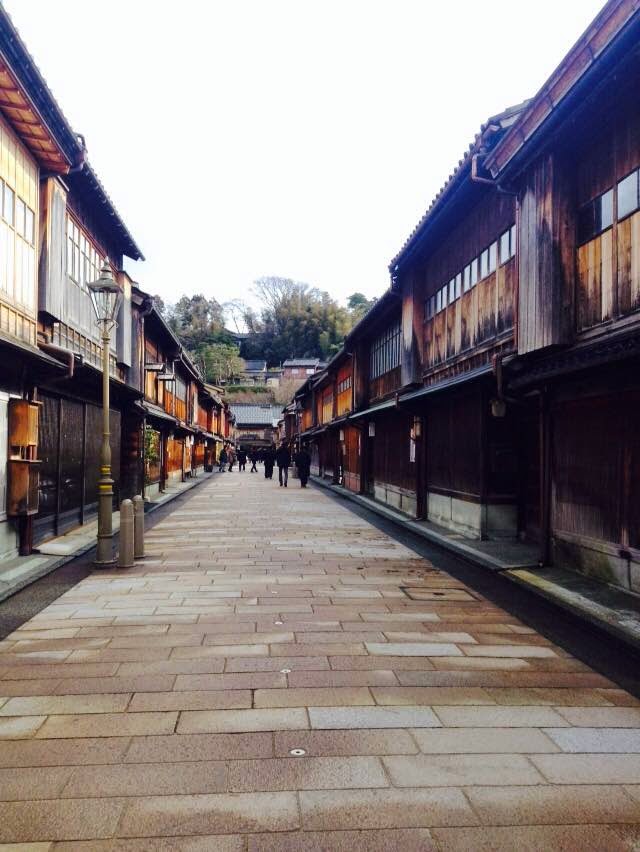
This area is called Higashi Chaya District. Higashi (ひがし/東) means "east", and Chaya (ちゃや/茶屋) means "a tea house". There're several Chaya districts in Kanazawa city, where Geisha (do you know Geisha?) entertains people by performing traditional dances. It may remind you of Kyoto, right? Yeah, Kyoto is the most famous area for foreigners to see Geisha! Kanazawa isn't as big and famous as Kyoto at all, but it's been called "小京都(しょうきょうと)" which means "Little Kyoto". You know why? ;)

It takes about 10 minutes by bus from Kanazawa station to Higashi Chaya District. Maybe less than 30 minutes on foot? Kazue-machi Chaya District is also a small Geisha district. I think there're a few guest-houses in this area. The riverside scenery is really pretty especially at the evening twilight time.
You can buy some souvenirs, try on a Kimono (Japanese traditional cloths), have a cup of Macha (Japanese green tea) with sweets... Oh, I almost forgot to say about 金箔(きんぱく) /kinpaku/ "gold leaf".
If you've been to Kyoto before, you must have seen 金閣寺(きんかくじ), Kinkakuji, the temple of the Golden Pavilion. (Google it if you haven't seen it yet!) It's covered in 金箔, gold leaf. You can see the very gold leaf in Kanazawa because 99% of metal leaf in Japan are produced here! Also, you can try gold leaf pasting! :D
Can you believe that gold leaf is less than 0.0001mm thick?
 |
| Can you see gold leaf floating on the surface of the tea? |
Don't forget to explore back streets when you go to Chaya districts!! :) Don't rush, don't hurry, take your time to see around town. This is the most important tip to enjoy sightseeing in Kanazawa.

Subscribe to:
Posts (Atom)