Hey guys! It's really hot recently, I'm sure Summer has come!!
It's not the cherry blossom season anymore, but I'd like to share this video today.
http://youtu.be/K_xTet06SUo
千本桜(せんぼんざくら) /sen-bon-zakura/
*千(せん)/sen/ a thousand(1,000)
*本(ぼん)/bon/ This is so called "counters" in Japanese language.
When we count long things (such as pens, trees, sticks) use 本.
It's a little confusing because we pronounce it in three different ways (ほん/hon/ ぼん/bon/ぽん/pon/). It depends on the number.
For example:
1本(いっぽん)/i-ppon/
2本(にほん)/ni-hon/
3本(さんぼん)/san-bon/
4本(よんほん)/yon-hon/
5本(ごほん)/go-hon/
6本(ろっぽん)/ro-ppon/
7本(ななほん)/nana-hon/
9本(きゅうほん)/kyuu-hon/
10本(じゅっぽん)/ju-ppon/
I found a useful video!! Check it out and learn Japanese counters. ;)
http://youtu.be/DDRbzW8AWEI
If you got depressed because it seems hard, I have a good news for you. These "counters" aren't so many as Chinese! Haha
*桜(ざくら)/zakura/ cherry blossom
さくら/sakura/ becomes ざくら/zakura/ in a compound word. It changes because /zakura/ is easier to pronounce after /bon/.
By the way in this video they're playing Japanese traditional instrumentals. Did you notice? Japanese traditional music is considered as old, boring and sluggish, but there're some nice songs which arranged traditional music. Do you like it?
The vocal girl wears 着物(きもの)/kimono/. Can you see? I've introduced 振袖(ふりそで)/furisode/ before, which is also one kind of 着物. It's gorgeous, isn't it!!
Recently I became a fan of 竹下夢二/Takeshita Yumeji/, who is a Japanese painter. Women he painted are very beautiful and fascinating.
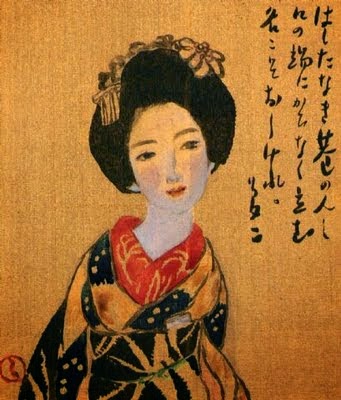
*Japanese Word of the Day*
美人(びじん)
/bijin/
a beautiful woman
The Kanji character 美 has a meaning of "bauty". And 人 means "a person".
XD
Yesterday is history. Tomorrow is a mystery. Today is a gift. That's why it is called the present.
Wednesday, June 18, 2014
Friday, June 13, 2014
Common Greeting Phrases in Japanese
Youtube is one of the awesome tools for learning a foreign language. I've studied basic Chinese on Youtube. There're also many videos which help you learn Japanese. I want to share one of it.
The title of the first lesson is はじめてのあいさつ. (First-meeting Greetings)
It has English subtitles from 1:40~. You can see its skit and key phrases on this website: https://www.erin.ne.jp/jp/
Lesson one : https://www.erin.ne.jp/en/lesson01/index.html
So I'm gonna pick up one phrase from this video to introduce you.
みんな、よろしく頼(たの)むな (2:35~)
/minnna, yoroshiku tanomu-na/
I want you all to welcome her.
You guys may already know, but Japanese people really love to use this phrase. Not only when you meet someone for the first time, but also when you ask someone to do something, or when you want to show someone your cooperative attitude, you can say よろしく.
日本(にほん)のことをたくさん勉強(べんきょう)したいので
/nihon no koto wo takusan benkyou shitai node/
I want to learn all about Japan
よろしくお願(ねが)いします。 (02:56~)
/yoroshiku onegaishimasu/
I'm pleased to meet you.
お願(ねが)いします can be translated as "please" in English. The informal, casual form of it is お願い.
お願い!!100万円(ひゃくまんえん)貸(か)して!!
/onegai!! hyaku-man-en kashite!/
Please!! Lend me a million yen!
1 /ichi/
10 /juu/
100 /hyaku/
1,000 /sen/
10,000 /ichi-man/
100,000 /huaku-man/
円/yen/ is a Japanese currency.
あ、「さき」で良いから。よろしくね! (03:24~)
/a, saki de ii kara. yoroshiku ne/
Oh, "Saki" is fine. Nice to meet you!
Saki is a girl's name. (How Can I Call You?) ね at the end of the sentence makes the sentence friendly. (See more explanation about ね in this post!)
These よろしく are used as greetings. As I said, we often use よろしく to ask someone to do something.
このプロジェクトは君(きみ)に任(まか)せた。よろしく頼(たの)むよ。
/kono purojekuto wa kimi ni makaseta. yoroshiku tanomu yo/
I'm leaving this project to you. I'm counting on you.
ついでにこれもよろしく!
/tsuideni kore mo yoroshiku/
While you are at it, do me this favor!
When I'm washing dishes, my husband often comes over and hands me a mug that he used and says this phrase. Or, when I want him to mail a letter for me on his way, I hand him a letter and say it.
An the last phrase is;
これからもよろしくお願(ねが)いします。
/korekara mo yoroshiku onegai shimasu/
Please continue your support. Please keep in touch. I look forward our continued acquaintance. Be my friends all the time. I ask you further kindness... and so on!!
;)
Saturday, June 7, 2014
Hardest Languages?
Learning a foreign language is not easy. If you've learned several languages, you may have found that some languages are comparatively harder than others. For native English speakers, to pick up Spanish is easier than to pick up Japanese. You'd feel more difficult to learn a certain language because it has less similarities to your mother tongue. Or, there're few materials to learn that language.
I want to share this infographic, which shows THE HARDEST LANGUAGES TO LEARN (for native English speakers). It's interesting. :)
(Source: http://voxy.com/blog/index.php/2011/03/hardest-languages-infographic/)

Via: Voxy Blog
Well, according to this infographic, Japanese is categorized as HARD language. What do you think? It also means, it is very hard to learn English for me (a native Japanese speaker), right? It is, it is. So I'd be really appreciate it if you would help me with my English!X)
But it won't matter if it is the hardest language, if you really want to learn it.
*Japanese Word of the Day*
やればできる!!!
/yareba dekiru/
I can do it if I do!!!
As you see, it doesn't have a subject. So it can be "YOU can do it" "WE can do it", or someone else can do it. It depends on the situation. Japanese language really loves to omit its subject in a sentence.
*やれば/yareba/ is the ba-conditional form of やる(to do). This form indicates the meaning of "if" "when" or "in case".
*できる/dekiru/ can do
ex) 正直(しょうじき)、できるかどうか、自信(じしん)がない。
/shoujiki, dekiru ka douka, jishin ga nai/
Frankly, I'm not sure whether I can do or not.
*~かどうか/...ka douka/ whether or not
*自信/jishin/ confidence
*ない/nai/ don't have, there aren't ⇔ ある/aru/ to have, there are
We never succeed if we don't try it. :)
Anyway, have a happy weekend!!
I want to share this infographic, which shows THE HARDEST LANGUAGES TO LEARN (for native English speakers). It's interesting. :)
(Source: http://voxy.com/blog/index.php/2011/03/hardest-languages-infographic/)
Via: Voxy Blog
Well, according to this infographic, Japanese is categorized as HARD language. What do you think? It also means, it is very hard to learn English for me (a native Japanese speaker), right? It is, it is. So I'd be really appreciate it if you would help me with my English!X)
But it won't matter if it is the hardest language, if you really want to learn it.
"If you believe Japanese is difficult, vague, and illogical, it will be for you. But if you focus on the easy, concrete, logical bits first, you will learn much faster, and have a hell of lot more fun along the way. " ~John Fotheringham, Fluent in 3 Months: Is Japanese Hard? Why Japanese is easier than you think!
*Japanese Word of the Day*
やればできる!!!
/yareba dekiru/
I can do it if I do!!!
As you see, it doesn't have a subject. So it can be "YOU can do it" "WE can do it", or someone else can do it. It depends on the situation. Japanese language really loves to omit its subject in a sentence.
*やれば/yareba/ is the ba-conditional form of やる(to do). This form indicates the meaning of "if" "when" or "in case".
*できる/dekiru/ can do
ex) 正直(しょうじき)、できるかどうか、自信(じしん)がない。
/shoujiki, dekiru ka douka, jishin ga nai/
Frankly, I'm not sure whether I can do or not.
*~かどうか/...ka douka/ whether or not
*自信/jishin/ confidence
*ない/nai/ don't have, there aren't ⇔ ある/aru/ to have, there are
We never succeed if we don't try it. :)
Anyway, have a happy weekend!!
Friday, May 30, 2014
Kanji Lesson
Happy?
Have fun like them!!
Recently some of my friends asked me how to learn Kanji characters in Japanese.
So I thought back on what I did to learn them when I was a kid. I am sorry but I have to say that I (and most of other Japanese people) just practiced Kanji characters again and again in school. I had a lot of homework to write Kanji characters and often took the exams.
The Japanese students must master 2,136 Kanji characters at the level of high school graduation. It means, we spend 12 years to master all of them.
These are articles about Kanji characters I posted before:
*Let's Learn Kanji Characters!
*A Misunderstanding
It would be more easier to learn them if you could find some characteristics of Kanji characters. Here's an example:
汁 soup
汗 sweat
河 river
泡 bubble
泳 to swim
海 the sea
浴 to bath
Can you find the something these characters have in common? Look closer at the left side of each characters. All of them have 氵 on its left. And, you might have already noticed, those characters' meanings have relation to "water". Right, this part of Kanji (氵) is kinda like a keyword of "water".
Now try to guess what's the meaning of this keyword (扌) of these Kanji characters.
Hint: A body part!!
打 to hit
投 to throw
技 skill
指 fingers
拾 to pick up
Answer: This (扌) is a keyword of "hands". Did you get it?:)
If you've just started to learn Kanji characters, these website would help you a lot!!
>How to Learn 2,000 Kanji in 3 Months
(Fluent in 3 Months)
>Basic Kanji - The First to Learning Kanji
(CosCom)
*Japanese Word of the Day*
あれ?どうやって書くんだっけ?
/are? douyatte kaku-n dakke?/
Eh? I forgot how to write it?
*あれ?/are/ ん?/n/ え?/e/ (・_・?)
*どうやって /douyatte/ how to
*書く /write/ to write
*~だっけ? /-n dakke/ is it...?
= ~だったっけ? /dattakke/
It implies that he's not sure about it, or forgot about it. Or he's asking himself.
ex) 犬(いぬ)にチョコレートあげても良(い)いんだったっけ?
I'm not sure if I can give some chocolates to dogs...?
ex) ごめん、名前(なまえ)なんだったっけ?
Sorry, what was your name?
I often forget how to write Kanji when I have to write by hand because I usually use a keyboard and the computer automatically choose Kanji for me. :(
Friday, May 23, 2014
Japanese is easier than you think!!
Have you tried Lang-8? It's a language learning platform where native speakers correct what you write. if you're learning Japanese and have already studied Japanese characters, I recommend you to try writing some in this website!
Even if you don't use Japanese software, don't worry. You can also input Japanese characters without a Japanese keyboard. Here is the website which explains how to type in Japanese on your laptop;
How to type Japanese
http://www.coscom.co.jp/learnjapanese801/
by. CosCom
And here's some useful tips to switch between ひらがな and カタカナ.
Alt + Caps Lock is Hiragana -> Katakana (Full width)
Ctrl + Caps Lock is Katakana (Full width) -> Hiragana
Left alt + backtick (`) is used to switch between hiragana mode and direct input
*Thank you for telling me these tips, Adgemon! :)
And, today I'm gonna share a great blog post!!
Is Japanese Hard? Why Japanese is easier than you think!
by. FLUENT IN 3 MONTHS
I am a big fan of that blog!! X) The owner of the blog is Benny Lewis, who is a polyglot and has mastered several languages. You can find a lot of ideas for leaning languages in his blog. In this article, as the title says, it shows some reasons why Japanese isn't as hard as you might think.
*There are heaps of English loan words in Japanese
*There are no pesky noun genders in Japanese
*Japanese verbs don't have to "agree" with the subject
*You can leave out the subjects & objects if they are clear from the context
*Each Japanese syllable can be pronounced only one way
*Japanese harbors few new sounds for English speakers
*Japanese is not a "tonal" language
*Kanji can be learned extremely quickly if you use an adult-friendly method
*Knowing Kanji allows you to guess the meaning of new words
Please check out these great advice by clicking the link above!! ;)
*Japanese Word of the Day*
なんだ、思(おも)ってたより簡単(かんたん)じゃん。
/nanda. omotteta-yori kantan jan/
Oh it's no big deal, it's easier than I thought.
*なんだ /nanda/ You say it when you don't satisfied with the result, or it's not good enough as you expected. It is also pronounced like なーんだ/naanda/ with a disappointed tone.
*思ってたより /omotteta yori/ than you expected
If you want to say as negative form, you have to say 思ってたほど.
思(おも)ってたほど可愛(かわい)くなかった。
(She was) not as cute as I expected.
思(おも)ってたほど楽(たの)しくなかった。
It wasn't as fun as I expected.
*簡単 /kantan/ easy ⇔ 難(むずか)しい /muzukashii/ hard, difficult
*じゃん /jan/ We put it at the end of the sentence to emphasize it. Or it's used to confirm the positive. Well, people in the west part of Japan (especially in Kansai area) usually say やん /yan/ instead of じゃん.
Learning a foreign language isn't easy, but it's interesting. Right?:)
Tuesday, May 20, 2014
What Should I Talk About?
Hey guys! I've heard an interesting method for Language Exchange (LE).
This method is for beginners who have just learned basic grammar and some vocabulary.
(Google it if you don't know what's LE!!)
(Preparation)
1. Decide one topic to talk about
2. Make 5 sentences about the topic in the target language
3. Check some vocabulary related to the topic before the session
(In the Session)
1. Your partner (or you) speeches 5 sentences
You might find many mistakes in your partners speech, but please listen till the end.
2. Let your partner know the mistakes or more natural way to say that
If you don't remember the sentences, you can ask your partner to read it again.
3. Speech corrected 5 sentences
4. Ask your partner 5 questions about her/his speech or about the topic
Please use simple and easy word so that your partner can understand
5. Switch the language
Now it's your (or your partner's) turn to speech 5 sentences.
1~4. again!
It would take 15 or 20 mins per person. It's very easy, isn't it? :)
I think it's much better to have a 20 mins session twice a week than to have a 2 hours session once a month. What's important is to keep it, right?
You wanna try it but haven't found any LE partners? :(
Then, please check my old posts which introduce some useful websites for LE!
→Language Exchange SNS <Lang-8>
→Find A Language Exchange Partner
And check this post if you want to start LE with Japanese friends.
→Japanese Phrases For Language Exchange
I currently tried this method with an Iranian lady. It was good for us, who are very shy and often freeze up! lol Please try it and let me know how it works for you guys!! :)
*Japanese Word of the Day*
緊張(きんちょう)しちゃって・・・何(なに)話(はな)せばいいかわかんないよ。
/kinchou shichatte... nani hanaseba ii ka wakannai yo/
I feel so nerves... that I have no idea what to talk about.
大丈夫(だいじょうぶ)、リラックス、リラックス!
/daijoubu, rirakkusu, rirakkusu/
No worries, just relax!
*緊張(きんちょう) /kinchou/ to feel nerves, embarrassed, to get tense
We often say 緊張する before a big workout. しちゃう is very casual way of saying する. It implies that it's not what one wants to do, or it's out of one's control.
ex) そんなこと言(い)ったら、彼女(かのじょ)泣(な)いちゃうよ
If you said like this, she will cry.
泣く [to cry] → 泣いちゃう [to cry, but it's not supposed to cry]
ex) ごめん、笑(わら)っちゃった。
Sorry, but I couldn't help laughing out.
笑う[to laugh] → 笑っちゃう ―(past sense)→ 笑っちゃった
*何(なに) /nani/ what
*話(はな)す /hanasu/ to talk, speak
*いい /ii/ good, fine, proper, okay → いいか(=いいかどうか) good or not
何を話せばいいか means "what to talk / what should I talk"
ex)何を買(か)えばいいか
What to buy
ex)何から食(た)べればいいか
What should I eat first
から shows the starting point. 何から literally means "from what".
Check this post to know more about から!
*わかんない/wakannai/=わからない I don't know, I'm not sure
*大丈夫(だいじょうぶ)/daijoubu/ don't worry, never mind, no problem, it's okay
We really often use this word!
ex)映画(えいが)、明日(あした)でも大丈夫(だいじょうぶ)?
Is it okay to go to cinema tomorrow?
ex)ケガはもう大丈夫(だいじょうぶ)なの?
Is your wound okay now?
*リラックス/rirakkusu/ to relax
There're tons of loan words from English in Japanese. xD We say リラックスする when it's used as a verb.
Saturday, May 17, 2014
It Will Be Found Out Soon!!
I found an interesting Youtube video which introduces Japanese Supermarket!
What do you think about it? Does it look unique? :)
A few weeks ago, my friend Alley asked me what is the difference between "ようだ" and "そうだ". Both words explain the speaker's supposition or presumption. They are really often used in conversations. Let's look over how to use these words!
Here's some examples;
(1)太郎(たろう)の浮気(うわき)がバレたようだ。
/tarou no uwaki ga bareta youda/
It seems that Tarou's fling was found out.
太郎(たろう) is a boy's name. Someone came to know that 太郎's bad habit 浮気(うわき) was found out. What does 浮気 mean? It means "one's fling (love affair)". You can guess what will happen when one's 浮気 was found out by his girlfriend or his wife...!! lol
バレる /bareru/ means "to be found out". It's used for something bad, or something you don't want others to know.
(2)太郎の浮気がバレたそうだ。
/tarou no uwaki ga bareta souda/
I've heard that Tarou's fling was found out.
In this case, (1)ようだ means "it seems that..." and (2)そうだ means "I've heard that..."
How about this example;
(1)雨(あめ)が降(ふ)るようだ
/ame ga huru youda/
It seems that it will rain.
(2)雨が降るそうだ
/ame ga huru souda/
I've heard that it will rain.
(3)雨が降りそうだ
/ame ga huri souda/
It looks it will rain soon. / It is about to rain.
The usage of (1)ようだ and (2)そうだ is same as Tarou's example. However, look at (3). It might be a little confusing though. It also そうだ but it's a little different from the meaning of (2)そうだ.
You'll see the difference if you see closer at its verb.
(2)雨が降るそうだ → I've heard that it will rain
(3)雨が降りそうだ → It looks it will rain soon. / It is about to rain.
食べ(=eat)そうだ、走り(=run)そうだ、泣き(=cry)そうだ、飛び(=fly)そうだ... These actions haven't happened yet, but it looks it will happen. Or, it shows that it is your conjecture by seeing.
But you cannot say 雨が降りようだ, 食べようだ, 走りようだ... They don't make sense.
So, if I say 太郎の浮気がバレそうだ, it means totally different from 太郎の浮気がバレたそうだ. His fling hasn't been found out yet, but you saw something and suppose that it will be found out sooner or later.
Oh gosh, it's hard to explain... I hope you can find some rules through these sentences.
You can also see my previous posts which have some examples with the word "そうだ".
⇒ ともちゃんって、ほんと悩み事とか無さそうだよね。
⇒ 元気そうだね、どうしたの?
⇒ 雨が降りそうだから、傘を持っていく。
These そうだ show one's conjecture by seeing something.
By the way, my husband will get back from business trip at last!! XD I'm soooo happy now!!
*Japanese Word of the Day*
彼(かれ)は明日(あした)帰(かえ)ってくるそうだ。
/kare wa ashita kaette-kuru souda/
I've heard that he'll be back tomorrow.
Subscribe to:
Posts (Atom)


